Creative Designer
Visual Thinker
Art Teacher
Metalsmith
Painter
Creator
I'm a designer, dedicated to crafting cohesive brand experiences and intuitive interfaces that genuinely impact how people engage with a product. With a background spanning brand identity, iconography, and product design, I thrive where aesthetic meet usability.
My process is grounded in understanding user needs, championing accessibility, and building scalable design systems. Whether I'm defining the visual language for a new product or refining an existing experience. I believe that great design should be as purposeful as it is beautiful.

Remote Express App
I collaborated closely with our Product Manager on the development of this new project, which complements our existing software used by law enforcement agencies to track and manage Registered Sex Offenders.
This new mobile application is designed to significantly ease the administration burden on law enforcement. By allowing registered sex offenders to complete required registration processes directly from a mobile device, agencies can reduce in-office traffic, streamline workflows, and allocate staff time more effciently.
Ultimately, this solution enhances operational efficiency while maintaining compliance and oversight standards.
1st Iteration
Verifying screens

In this first iteration of the address verification feature, we implemented a workflow that presents the registered sex offenders with multiple addresses on file, including one incorrect option. This serves as an identity and residency verification step, helping ensure the individual confirms the correct address while preventing fraudulent updates.
Additionally we incorporated GPS tagging to capture the offender's real-time location at the time of submission. This provides an added layer of verification by cross-referencing the device's current location with the reported address, strengthening compliance oversight and improving data accuracy for law enforcement agencies.

2nd Iteration
Verifying screens


In the next iteratiom of the address verification workflow, we simplified the user experience while maintaining compliance safeguards. Instead of displaying an address prompt for conformation, the application asks the offender whether they are currently at home and whether the location is their primary residence. We intentionally chose not to display the address on file to require an active affirmation from the user.
If the offender indicates they are not at home, the application prompts them to provide a written explanation of their current location. This ensues law enforcement agencies receive contextual information while maintaining accountability and improving the accuracy of residency reporting.

3rd Iteration
Verifying screens


Through continued discussion with stakeholders and law enforcement liason (LELs), we identified the need for a simplified and accessible registration option for homeless offenders. Because registration requirements vary by state - ranging from daily to weekly or monthly check-ins - we recognized the importance of creating a flexible yet compliant solution that can adapt to differing legal standards.
To streamline the process and reduce administration burden, this iteration introduces a location-based check-in feature. Instead of requiring a traditional address, users can move a map pin to indicate where theyare currently staying or spending the night. This approach enables faster, more accurate reporting while accommodating individuals without a fixed residence.
The goal is to balance regulatory compliance with usability, ensuring agencies receive reliable location data while providing a practical check-in method for homeless registrants.
4th Iteration
Verifying screens

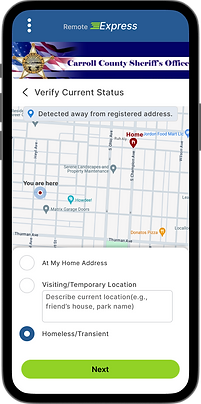
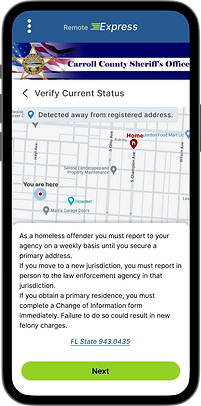
We have decided to present all primary options on a single screen. If the offender is currently at their registered address, they can select the corresponding option. If they are experiencing homelessness, the system will provide two alternative methods on subsequent screens for entering their current location.